
Case Study: Offshore Wind Electrical Pre-FEED

Offshore Wind Farm Pre-FEED: Building the Electrical Design Basis for FEED

A strong offshore wind Pre-FEED study should do more than describe a concept. It should test the electrical design choices that most affect compliance, losses, equipment scope, risk, and cost before the project moves into FEED.

Offshore wind Pre-FEED is used to define the outline project concept early enough to support the consent envelope and wider development decisions. For the electrical package, that early definition matters because export philosophy, array configuration, offshore and onshore substation assumptions, reactive compensation approach, and grid code strategy all interact.

If those choices are not tested early, projects can carry avoidable risk into FEED: over-sized compensation plant, weak voltage control, late harmonic issues, unsuitable landing concepts, or network studies that force redesign when procurement thinking is already under way.

Offshore wind turbines at sea

Why electrical Pre-FEED is required

Offshore wind electrical design cannot be left as a generic placeholder before FEED. Even at outline stage, developers need an informed view of how the project will satisfy reactive power obligations at the grid connection point, how voltage will be controlled across long cable systems, and whether harmonic performance is likely to require filtering or more careful impedance management.

  • Reactive power capability and compliance strategy need to be chosen before equipment assumptions harden.
  • Long HVAC export and array cables can materially affect voltage control and charging reactive power.
  • Early harmonic assessment can prevent expensive late-stage filter or compensation redesign.
  • Load flow and fault level studies are needed to screen whether the concept is technically credible.
  • Several landing and connection arrangements should be compared before committing to FEED scope.

What good Pre-FEED changes commercially

Good electrical Pre-FEED is not just a technical exercise. It narrows the design space and creates a more bankable basis for FEED by identifying which options are robust and which are likely to drive avoidable cost.

  • Improves confidence in main equipment scope and compensation philosophy.
  • Reduces redesign risk when grid compliance studies become more detailed in FEED.
  • Supports a more credible estimate of losses, auxiliary requirements, and reactive plant needs.
  • Helps prioritise surveys and studies against the options that are genuinely worth developing.
  • Creates a cleaner handover into FEED and procurement discussions.

Choosing the reactive power compliance approach

One of the most important electrical design decisions in offshore wind Pre-FEED is how the project will achieve reactive power compliance at the point of connection. That is not simply a question of adding compensation later. The strategy affects export voltage selection, cable behaviour, transformer design, losses, operational flexibility, and sometimes the scale of offshore versus onshore plant.

At Pre-FEED stage we typically assess whether the reactive duty can be met primarily through turbine capability and plant control, through fixed or switched shunt compensation, through dynamic devices such as STATCOM or SVC solutions, or through a coordinated mix of these. The right answer depends on the cable charging profile, grid code obligations, the desired voltage control philosophy, and how much operational margin the project needs.

A good reactive power strategy should be technically compliant, operationally stable, and not over-engineered. That balance is best established early.

Why early harmonic assessment matters

Offshore networks are especially sensitive to harmonic and resonance issues because power electronics, transformers, and long submarine cables interact in ways that can shift with operating point and topology. Pre-FEED is therefore the right stage to test whether the concept is likely to need a harmonic filter or whether the system can remain within acceptable limits through more careful impedance and compensation design.

  • Screen the interaction between converter-based generation and the cable network.
  • Identify whether compensation devices may worsen resonance risk.
  • Check whether likely impedance characteristics point toward passive or tuned filter needs.
  • Avoid carrying an unrealistic no-filter assumption into FEED.

Load flow and fault level studies in Pre-FEED

Load flow and fault level studies are the backbone of an electrical concept review. They help verify whether the proposed arrangement can control voltages, transfer power efficiently, and remain credible under the range of operating states that matter for the project.

  • Voltage profiles across array, export, offshore, and onshore nodes.
  • Reactive power circulation and compensation duty across operating scenarios.
  • Equipment loading, losses, and controllability for alternative concepts.
  • Fault current contribution, switchgear implications, and protection constraints.

Comparing several options to find a robust and cost-efficient design

A worthwhile Pre-FEED study should not stop at one concept. We usually compare several landing, grid connection, and compensation approaches so the project can move into FEED with a design basis that is both technically robust and cost-efficient.

Connection landing options

Different landfall, cable route, and onshore interface arrangements can change losses, consenting complexity, constructability, and substation scope.

Compensation philosophies

We compare reactive support strategies to avoid carrying unnecessary plant cost or weak operating margins into FEED.

Voltage and transformer concepts

Voltage level selection and transformer arrangement influence losses, fault levels, and the practicality of the control strategy.

Harmonic risk options

If a filter looks likely, that should be surfaced early enough to influence platform, onshore substation, and cost planning.

How RenSolv would approach this scope

For offshore wind electrical Pre-FEED, our focus is on establishing the design basis that FEED can confidently build on. That means defining and comparing the electrical concepts that matter most rather than producing a superficial outline.

  • Reactive power compliance assessment and voltage control strategy selection.
  • Harmonic screening to determine whether a filter is likely to be required.
  • Load flow, losses, and fault level studies for shortlisted options.
  • Comparison of connection and landing concepts against robustness and cost.
  • A clear recommendation for the option to take into FEED.
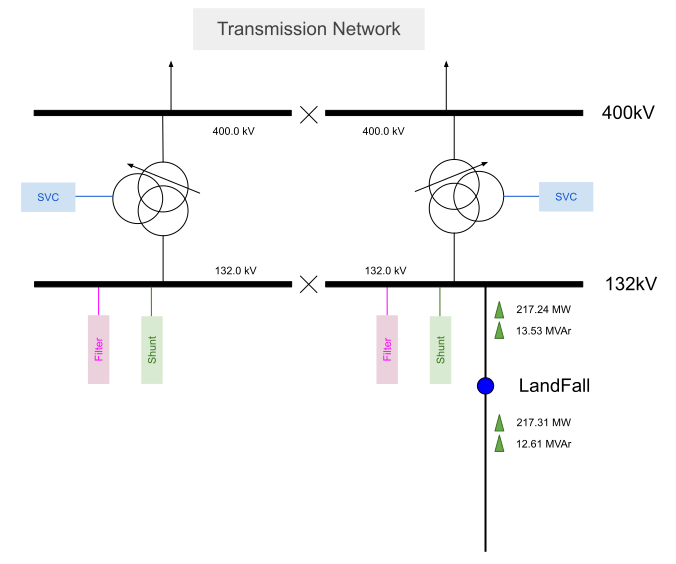
One-line electrical diagram

Discuss your offshore wind Pre-FEED requirements or an upcoming project with a RenSolv specialist engineer.

Book your free 30-minute consultation today.

Book your free 30-minute consultation