
Case Study: Curtailment Assessment in an ANM zone

Curtailment Assessment for a Solar Project: Why Independent Analysis Matters

An independent curtailment assessment for a 20 MW solar project showed how a more realistic, data-driven view can materially change the curtailment outlook.

Curtailment can make or break the commercial case for a renewable energy project. Yet in many cases, the first curtailment figure a developer sees is based on highly conservative assumptions that are appropriate for network screening, but not always representative of how a project is likely to operate in practice.

At RenSolv, we recently supported a 20 MW solar project with an independent curtailment assessment in an ANM area where the DNO provided extremely high curtailment figures. The purpose of the study was to review the network constraints, and refine the operational behaviour of loads and the generation queue bases on a fully data driven approach, while remaining aligned with the applicable curtailment assessment framework.

What this case showed very clearly is that curtailment outcomes are often highly sensitive to the assumptions sitting behind the headline number. In this anonymised project, the difference between a highly conservative view and a more realistic future-looking scenario was substantial.
Why curtailment assessments need careful engineering judgement

A curtailment assessment is not just a simple percentage. It is the output of multiple interacting assumptions about the future behaviour of the network and the projects connected to it. Two studies can both be technically valid, yet produce very different outcomes depending on how conservatively the assumptions are set.

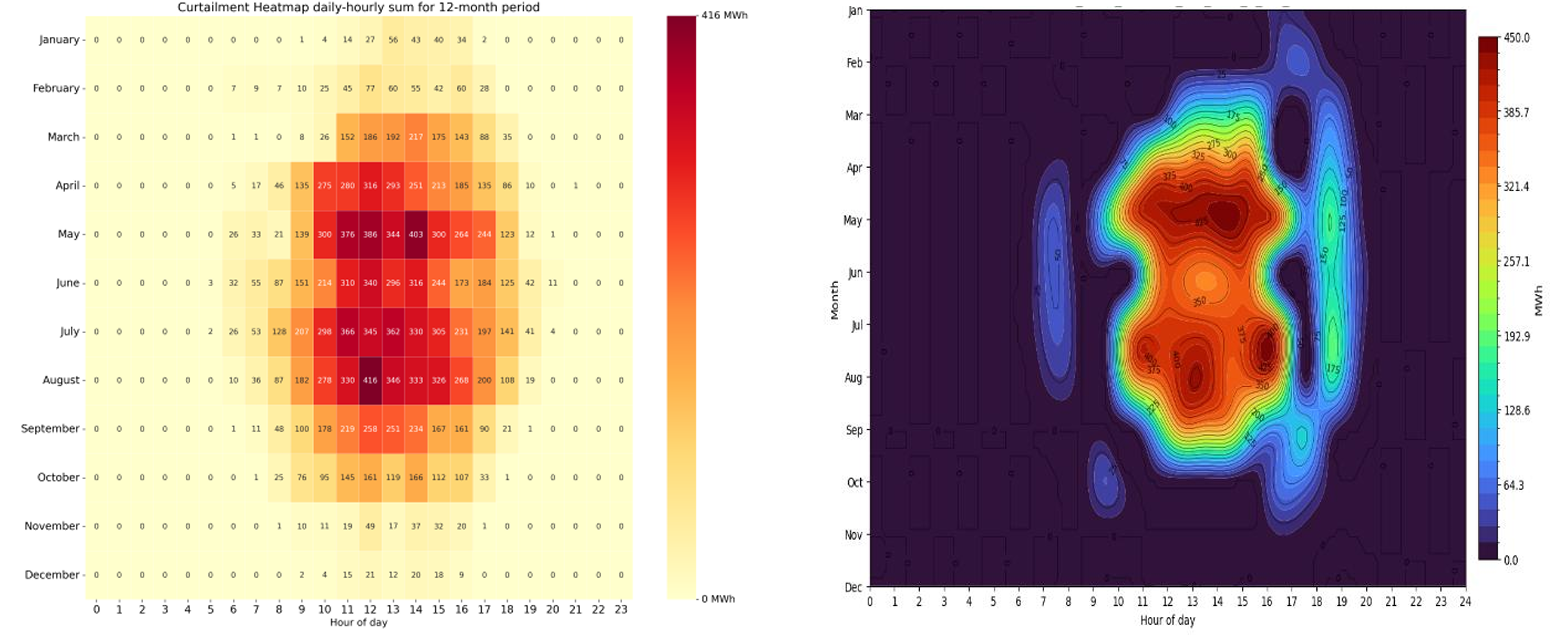
Comparison of DNO curtailment and RenSolv assessment in the first stage of an example project
Figure 1: Comparison of DNO curtailment vs our assessment in the first stage in an example project

That is why independent review matters.

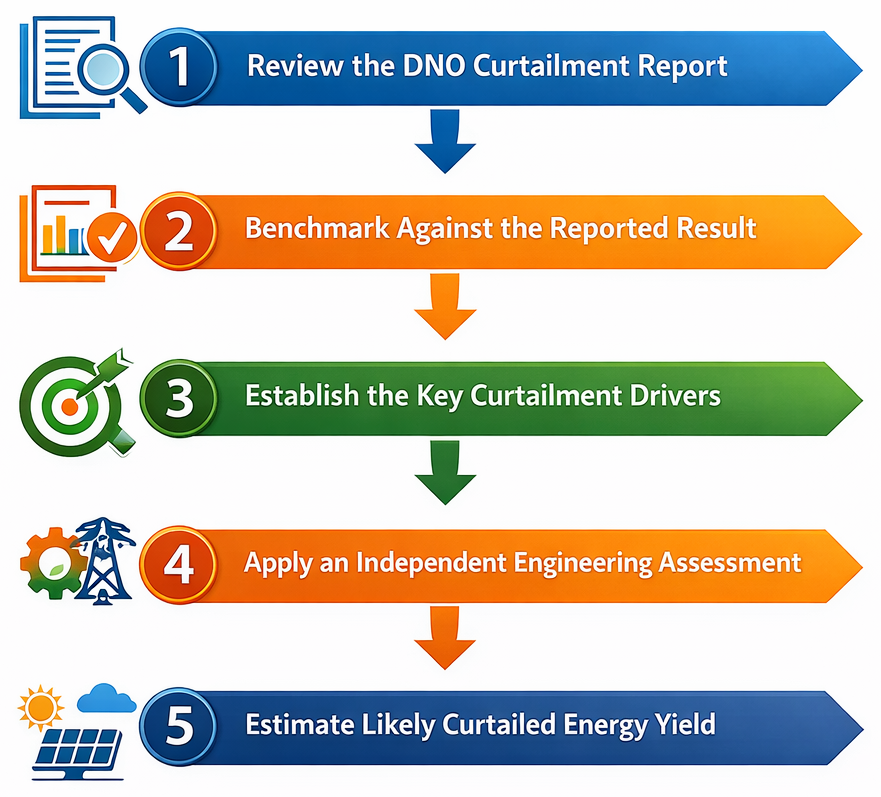
Where a DNO curtailment report is available, we first seek to understand it properly and, where appropriate, benchmark against the DNO's reported result. This is an important step because it helps establish whether the key drivers of the reported curtailment can be reproduced and understood before any independent forecasting is applied. Figure 1 illustrates the initial benchmarking stage, where the reported curtailment outcome is reviewed and compared against an independently reproduced assessment. From there, we carry out an independent, data-driven assessment using realistic engineering assumptions to estimate the curtailed energy yield a project is likely to experience in operation. The steps are also shown in Figure 2.

In practice, this often leads to outcomes that are less conservative than an initial DNO screening style report, while still remaining technically credible and suitably cautious for development-stage decision-making.

Typical steps performed for a curtailment assessment study
Figure 2: Typical steps performed for a curtailment assessment study

What developers should be looking for

For developers, investors, and landowners, the real question is usually not whether curtailment exists. The real question is:

What is a realistic expectation of curtailed energy over the life of the project, based on the best available evidence today?

That requires more than taking an initial headline percentage at face value. It requires a robust understanding of the factors that influence curtailment risk and how those factors may evolve over the life of the project.

This is where strong technical capability makes a difference. A good curtailment study should not simply provide a single curtailment figure. It should explain the curtailment drivers, where and when curtailment is expected to occur and, ultimately, provide a realistic, trustworthy and independent view that informs real project decisions.

Our experience across ANM zones

RenSolv is highly experienced in performing curtailment assessment studies across all ANM zones. We understand that each area has its own characteristics, constraints, and operational behaviours. We work within the relevant curtailment assessment framework, but we also recognise that meaningful project advice requires more than procedural compliance alone. It requires interpretation, benchmarking, and data forecasting.

Our work is designed to help clients answer the questions that matter commercially:

  • Is the curtailment risk genuinely prohibitive?
  • Is the initial figure likely to be overly conservative?
  • What range of curtailed energy outcomes is realistic?
  • How sensitive are the result to the study assumptions?
  • How might curtailment change over the life of the project?

What this project demonstrated

In this anonymised 20 MW solar farm case, our independent assessment showed that the likely curtailment risk was much lower than initially indicated by the DNO. This reinforced an important point that applies across many constrained areas: initial curtailment figures can sometimes make the likely real-world impact look worse than it is.

That does not mean the constraint disappears. It means the engineering analysis must distinguish between a theoretical worst case and a realistic operational forecast.

For clients, that distinction is critical. It can influence land strategy, bid decisions, project valuation, connection negotiations, financing discussions, and whether a project is progressed, paused, or redesigned.

Independent, technical, and commercially useful

At RenSolv we combine power systems expertise with practical commercial awareness and our role is to provide technically rigorous analysis that supports better decisions.

We do not rely on broad assumptions where better evidence can be applied. We review the available data, understand the behaviour of constrained networks, carefully interpret how risk may change over time, and provide an independent, data-driven assessment of likely curtailed energy yield.

That is the level of technical depth developers increasingly need in ANM-constrained areas.

What you receive from RenSolv

RenSolv provides professionally written technical reports prepared by specialist power system engineers with extensive experience supporting real grid connection projects.

Our reports are structured to give clients a clear and decision-useful view of curtailment risk, including the basis of the assessment, the key findings, the likely commercial implications, and the practical next steps where required.

Where appropriate, our work can also support engagement with the DNO by presenting the analysis in a clear, technically robust, and well-evidenced format.

Why Choose RenSolv

Deep technical capability with real project experience

We bring specialist power systems expertise backed by years of industry experience across grid connection, compliance, and network studies. Our work is technically rigorous, commercially grounded, and focused on the issues that matter most to project developers.

A practical and responsive working style

We work closely with our clients, communicate clearly, and focus on providing advice that is technically robust and easy to act on. Our aim is to make complex technical issues easier to understand and easier to manage.

Support beyond the study itself

Where needed, we support clients in discussions with the DNO and other project stakeholders. We do not see our role as simply issuing a report; we help clients use the analysis to move their projects forward with greater clarity and confidence.

If your project is facing a challenging curtailment outlook, or if you would like an independent view of curtailment risk in an ANM area, RenSolv can help you assess the likely operational impact through a technically robust, data-driven study.

Book a free 30-minute consultation to discuss your project.

Book a free 30-minute consultation